Short answer Timeless logos are simple, avoid trends, work in a single colour, carry meaning, use carefully chosen type and adapt to every size. They still change over time, but through small refinements rather than complete redesigns.
Why some logos last and others don’t
Some logos looked right decades ago and still look right today. Many others feel dated within a few years. The difference isn’t luck: the logos that last tend to follow the same handful of principles.
1. They’re simple
Nike’s swoosh, Apple’s apple, Target’s target. These marks are almost absurdly simple, and that’s exactly why they work. Simple logos are easier to recognise, easier to remember and easier to reproduce on everything from a billboard to a favicon.
The swoosh is a good reminder that simplicity doesn’t require a huge budget. It was designed by Carolyn Davidson in 1971, when she was a graphic design student, and it’s still the core of Nike’s identity.
A useful test: can you draw your logo from memory in about ten seconds? If not, it’s probably too complicated.
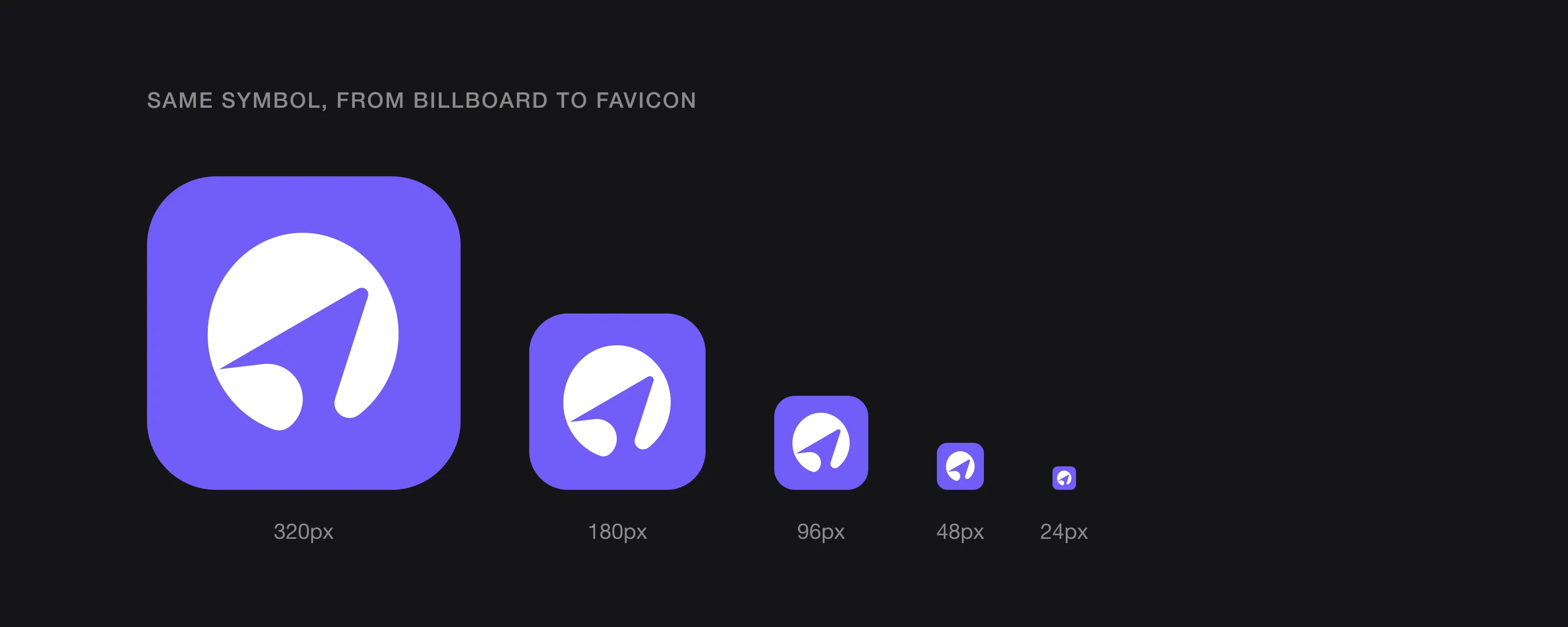 A simple mark survives every size, from billboard to favicon.
2. They don’t chase trends
Trendy logos have a shelf life. Think of the wave of flat geometric marks with gradients, or the years when every café had a hand-lettered script logo.
Timeless logos aim to be distinctive rather than fashionable. Coca-Cola’s flowing script dates back to the 1880s and, with refinements, is still in use. It lasted because it was unmistakably Coca-Cola, not because it matched a trend.
That doesn’t mean ignoring what’s happening in design. Just keep awareness and imitation apart. Our look at logo design trends in 2026 covers which trends are worth borrowing from and which to skip.
3. They work in a single colour
Timeless logos are usually designed in black and white first, with colour added afterwards. McDonald’s golden arches would still be recognisable in solid black. The Nike swoosh works in any colour you put it in. The shape does the work, not the palette.
If your logo falls apart without its exact colour combination, that’s a structural problem. Colour should reinforce a strong mark, not disguise a weak one. Colour still matters, of course: here’s how to choose logo colours once the shape is right.
 One idea that works in any single colour.
4. They carry meaning
In the best logos, every element earns its place. The hidden arrow between the E and x in FedEx. The arrow under Amazon’s wordmark that runs from A to Z and doubles as a smile. Adidas’s three stripes, which the brand repeats across its different logos and products.
When a logo has meaning built into it, people remember it and enjoy discovering it. Decorative logos, with random swooshes, needless outlines and generic icons, rarely create that connection.
5. The typography is chosen with intention
The typeface in a logo matters more than most people think. Enduring brands either adapt a classic typeface or have custom lettering drawn.
What they avoid is the font of the moment used as-is. Fonts that were everywhere for a few years quickly start to date the logos that used them.
If you’re choosing a typeface, look at designs that have lasted, such as Helvetica, Futura or Garamond, which have been in use for decades and still feel current. Better still, have a designer customise the letterforms so they’re yours.
6. They work everywhere
A timeless logo works on a business card, a billboard, a browser tab, an embroidered cap and a glass door. If yours only looks good at one size or on one background, it has a problem.
That’s why good logos are designed as systems: a primary version, an icon, one-colour and reversed versions, delivered in the right file formats. A logo that can’t scale has an expiry date.
7. They evolve without transforming
Here’s the nuance most people miss: timeless logos do change. Apple dropped the rainbow stripes from its apple in the late 1990s but kept the bitten-apple silhouette. Nike, Coca-Cola and Adidas have all refined their marks over the years.
The brands that feel timeless make careful refinements: cleaning up curves, adjusting proportions, simplifying details. They keep the core idea.
Burger King shows the other side. In 2021 it replaced its glossy 1999 logo with a flatter design close to the one it used from 1969 to 1999. The older, simpler logo turned out to have aged better than its replacement.
FAQ
How can I tell if my logo is too complicated?
Try to draw it from memory in about ten seconds. If you can’t, it’s probably too complicated.
Does a timeless logo need to work in one colour?
Yes. Timeless logos are usually designed in black and white first, with colour added afterwards, and a logo that falls apart without its exact colours has a structural problem.
Do timeless logos ever change?
Yes, but through careful refinements rather than complete redesigns. Apple dropped the rainbow stripes from its logo in the late 1990s but kept the bitten-apple silhouette.
Which fonts work best for a logo that lasts?
Enduring brands adapt a classic typeface or have custom lettering drawn, rather than using the font of the moment as-is. Helvetica, Futura and Garamond have been in use for decades and still feel current.
Which kind of logo lasts best depends on your name and business; our guide to the types of logos compares them.
The takeaway
A timeless logo isn’t about playing it safe or being boring. It’s about design decisions based on clarity, meaning and versatility rather than on what looks cool right now. Skipping those principles is often why cheap logos cost more in the long run: they need replacing sooner.
At Logomint, a senior designer creates your logo with these principles in mind, so it’s simple, meaningful and built to work wherever your brand appears. See the plans, from €129.