Short answer Start with how you want your brand to feel, check what your competitors use, then pick two or three colours that fit your audience and work on screen, in print and in plain black. Colour supports a strong logo; it can’t rescue a weak one.
Colour is the first thing people notice
Before someone reads your name or takes in the shape of your logo, they see its colour. That’s why colour matters. But it’s also why so much is written about it, and a lot of that writing overstates what colour can do.
You’ll often read precise figures about how much colour boosts recognition or drives buying decisions. Most of them can’t be traced back to solid research, so we won’t repeat them. What’s defensible is simpler: consistent colours make a brand easier to recognise, and colours carry cultural associations that can support (or undermine) the impression you want to make.
Common colour associations
These are common associations in Western markets, not scientific rules. Context, culture and execution change how a colour reads, and plenty of successful brands break the “rules” on purpose.
| Colour | Often associated with | Well-known examples |
|---|---|---|
| Red | Energy, urgency, passion | Coca-Cola, Netflix, YouTube |
| Blue | Trust, stability, professionalism | PayPal, IBM, Facebook |
| Yellow | Optimism, warmth, friendliness | McDonald’s, IKEA, Snapchat |
| Green | Growth, health, nature | Spotify, Whole Foods |
| Orange | Enthusiasm, creativity, playfulness | Fanta, Etsy |
| Purple | Luxury, imagination, creativity | Cadbury, Twitch |
| Black | Sophistication, authority, premium | Chanel |
| White | Simplicity, cleanliness, modernity | Often used as space around a mark rather than as the main colour |
Notice that blue is used by a payment company, a tech giant and a social network. The colour doesn’t create trust on its own; the brand earns it, and the colour becomes linked to it over time.
How to choose your colours in 4 steps
1. Define the feeling first
Before you look at a single swatch, write down three words that describe how your brand should feel. Trustworthy? Energetic? Premium? Playful? Start with the feeling, then look for colours that support it.
2. Study your industry
Look at the colours that dominate your market, then decide whether you want to fit in or stand out. If every competitor uses blue, that tells you something about what customers expect. It can also be an opportunity: a different colour makes you easier to spot in a crowded search result or on a shelf.
Our industry guides show what this looks like in practice, from why so many finance logos are navy blue to how beauty and real estate brands can stand out.
3. Consider your audience and markets
A study of colour–emotion associations across 30 countries found many of them are shared, but they still vary between cultures, age groups and contexts. White is linked to weddings in many Western countries and to mourning in parts of Asia. If you sell across borders, check how your palette reads in your key markets.
4. Test in real contexts
Colours shift between screen and print, on light and dark backgrounds, and at large and small sizes. Test your palette on a website header, a social avatar, a printed card and your packaging before you commit. Make sure you get the colour codes for both uses (HEX and RGB for screens, CMYK for print) along with the right logo file formats.
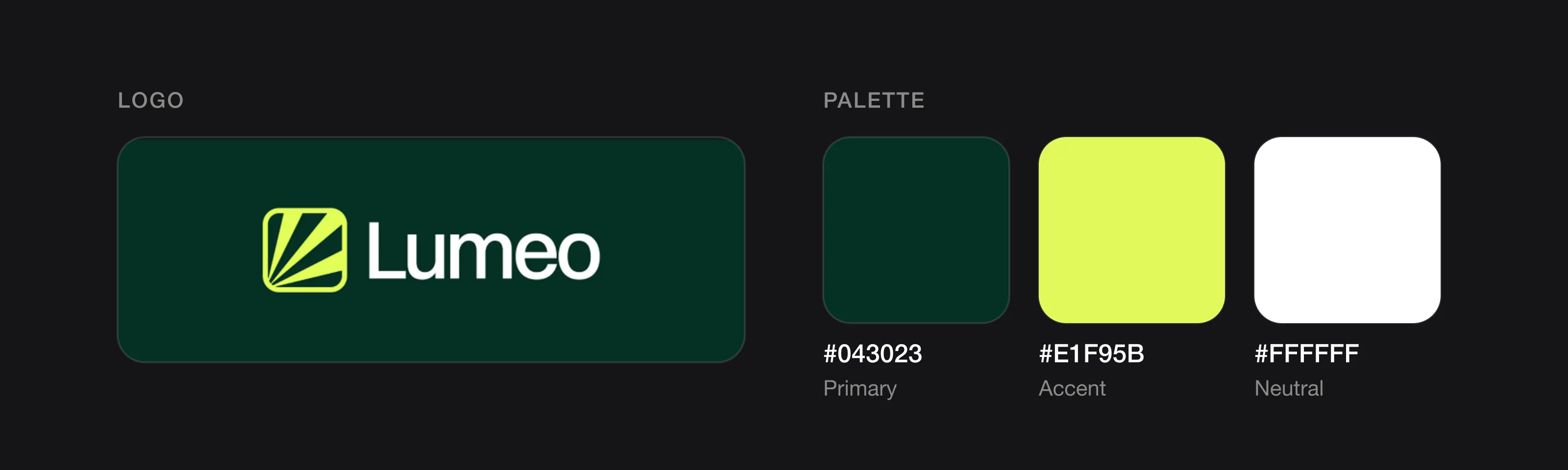 A logo and its palette, with HEX codes (Lumeo, designed by Logomint).
Colour mistakes to avoid
Using too many colours
Two or three colours are enough for a primary palette. Every extra colour makes the brand harder to recognise and harder to reproduce consistently. Clashing or excessive colours are one of the most common reasons a logo looks cheap.
Choosing colours you personally like
Your logo is for your customers, not for you. You might love purple, but that doesn’t make it right for your accounting firm. Separate personal taste from what the brand needs to communicate.
Ignoring accessibility
Colour vision deficiency is common: roughly 1 in 12 men and 1 in 200 women have some form of it, most often difficulty telling red from green. Make sure there’s enough contrast between your logo and its background, and don’t rely on colour alone, such as a red and green combination, to carry meaning.
Following colour trends
A colour of the year is interesting, but it’s not a brand strategy. Pick colours that will still suit your business in ten years, not just this season. It’s one of the principles behind logos that stay timeless.
The black-and-white test
Every good designer follows this rule: your logo must work in solid black before any colour is added. If the mark is weak without colour, colour will only hide the problem for a while.
The strongest logos work in any single colour because their shape does the work. Colour then reinforces a mark that already stands on its own.
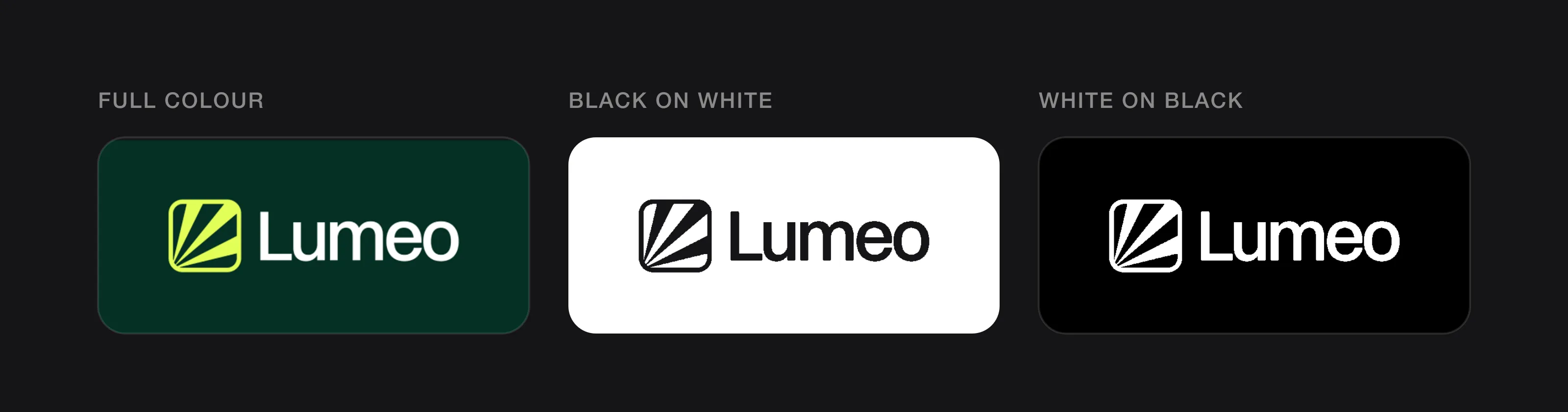 The black-and-white test: if the logo still works without colour, the colour is doing its job (Lumeo, designed by Logomint).
FAQ
How many colours should a logo have?
Two or three colours are enough for a primary palette. Every extra colour makes the brand harder to recognise and harder to reproduce consistently.
Does a blue logo make customers trust you?
Not on its own. Blue is often associated with trust, but the brand earns that trust and the colour becomes linked to it over time.
Should a logo work in black and white?
Yes. Your logo should work in solid black before any colour is added, because if the mark is weak without colour, colour will only hide the problem for a while.
What colour codes do I need for my logo?
You need HEX and RGB codes for screens and CMYK codes for print. Colours shift between the two, so test your palette in both before you commit.
Putting it together
Colour isn’t a magic formula. Making your logo blue won’t make people trust you. But when your colours match your positioning, your audience and your market, they reinforce everything else you do, and getting them right from day one saves you from an early rebrand. If you’re building a brand on a budget, that matters.
At Logomint, a senior designer chooses and tests your colours as part of the logo, with first concepts in 48 hours and full source files included. You can see the plans, starting at €129.