Short answer An e-commerce logo has to work on packaging, shipping boxes, favicons, marketplace thumbnails and social avatars, not just your store header. Design it for the smallest and hardest uses first, and get a full set of versions and vector files from the start.
E-commerce logos have a harder job
A consultant’s logo lives on a website and a business card. A DTC brand’s logo has to work on your Shopify storefront, product labels, shipping boxes, tape and stickers, Instagram stories, ads, marketplace listings, email headers and, if you scale, retail shelves.
That’s a very different design challenge, and many founders only discover it after they’ve picked a cheap AI-generated logo and started printing.
If you sell beauty or skincare products, our beauty brand logo guide goes deeper into small bottles and tubes. For apparel and equipment, see the sports brand guide, and for food and drink, the agriculture and food guide.
Where your logo actually appears
Before looking at mistakes, it’s worth listing the places an online store’s logo has to perform:
| Touchpoint | Typical challenge | What you need |
|---|---|---|
| Store header | Wide, short space | Horizontal version |
| Favicon | Shown at 16 to 32 pixels in a browser tab | Simple icon-only version (Google requires favicons to be square) |
| Social avatars | Cropped into a circle, viewed on a phone | Square icon that survives the circular crop |
| Marketplace thumbnails | Shop icons on Etsy, Amazon and similar are shown tiny, next to competitors (Etsy notes yours appears much smaller in feeds, receipts and its app) | Bold icon, readable without the full name |
| Packaging and labels | Small labels, printing on kraft or coloured card | One-colour version, CMYK colour codes |
| Shipping boxes, tape, stickers | Cheap one- or two-colour print, sometimes stamping | Single-colour and white versions |
| Photos and ads | Placed over busy images | Versions for light and dark backgrounds |
If your logo only works in one or two of these rows, you’ll feel it every time you launch a new product or channel.
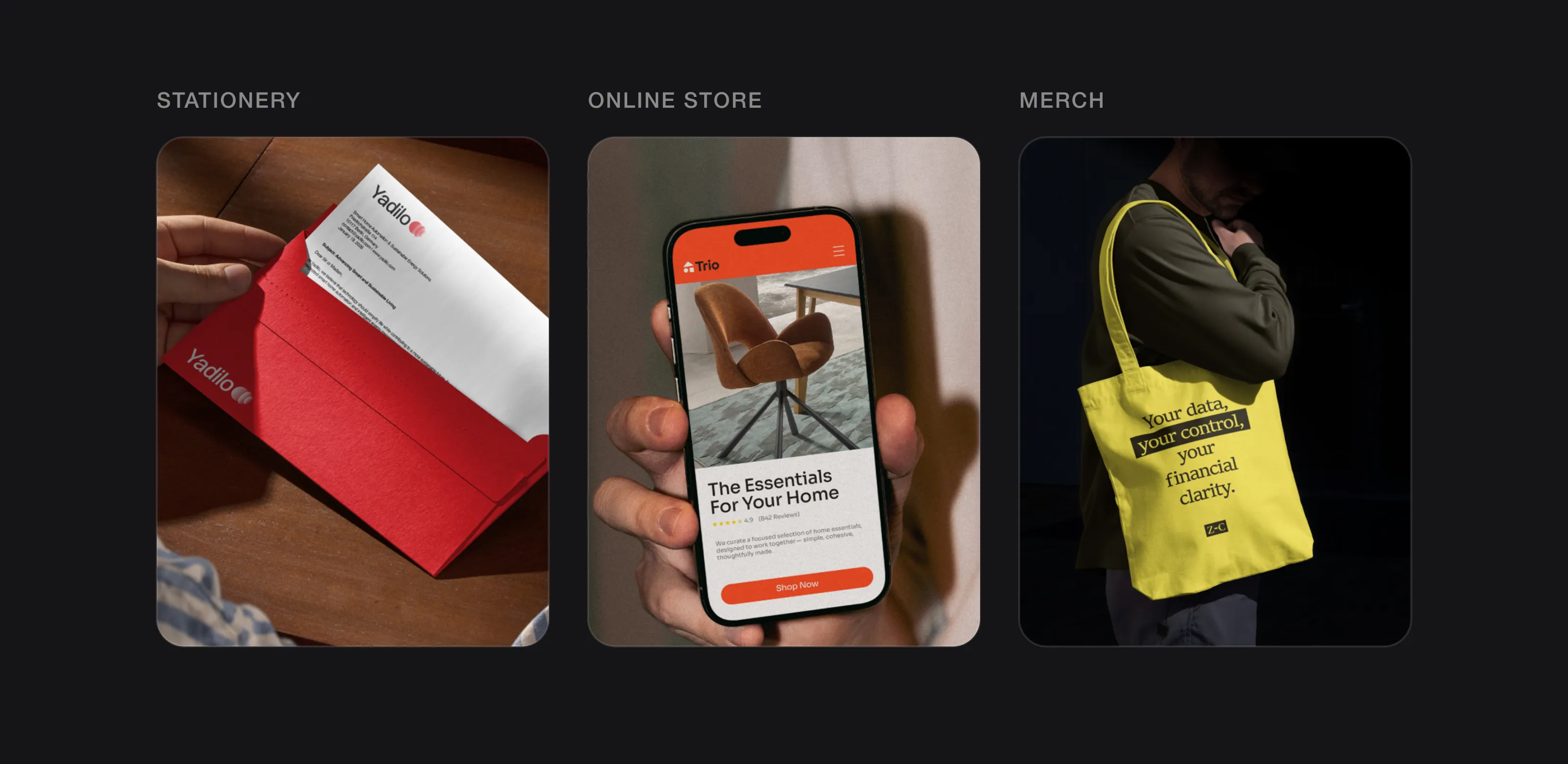 An e-commerce logo lives on stationery, the store and merch (Yadilo and Trio, designed by Logomint).
The 3 mistakes DTC brands make
Mistake 1: designing for screens only
Your logo looks great in your website header. But have you tried it on a shipping box, or on a product label the size of a credit card? Physical products expose weaknesses that screens hide: thin lines disappear, detailed icons turn muddy and gradients print unevenly.
The fix: design for the hardest use first. If your logo still reads at 2.5 cm wide, printed in one colour on a kraft box, it will work almost everywhere else.
Mistake 2: following trends instead of building recognition
E-commerce moves fast, and so do its design fashions. Chasing them means your brand looks like everyone else this year and dated next year, which is expensive once the logo is printed on thousands of boxes and labels.
The fix: choose recognisable over fashionable. A logo built on simplicity, versatility and memorability outlasts trend cycles, which is exactly what makes a logo timeless.
Mistake 3: a logo, but no system
A logo alone isn’t a brand. Without a few simple rules, your product pages look different from your Instagram, which looks different from your packaging, and customers take longer to recognise you.
The fix: set basic brand rules from day one: how and where to use each logo version, exact colour codes (HEX for web, CMYK for print, and Pantone if you print premium packaging) and which fonts to use. It doesn’t have to be expensive; our guide to startup branding on a budget shows where to start.
What makes a great e-commerce logo
- Scalable: works from a 16-pixel favicon to a 2-metre trade show banner, which requires vector files and a design that keeps its structure at every size.
- Versatile: works on white and dark backgrounds, coloured packaging, photos and transparent stickers.
- Memorable: customers who bought once should recognise you instantly in their inbox, in their feed or on a friend’s shelf. Simple, distinctive marks are remembered.
- Print-ready: clean shapes, correct CMYK colours and a single-colour version for affordable printing.
The e-commerce logo checklist
- Vector source files (SVG, AI, EPS), essential for packaging and printers
- Full-colour, one-colour and white versions
- Horizontal and stacked layouts
- Icon-only version for favicons, marketplace thumbnails and social avatars
- Transparent PNGs for your store and email templates
- Colour codes in HEX, RGB and CMYK
- A minimum size for each version
If your current logo package is missing more than two of these, you’ll run into problems as you expand into physical products, marketplaces and retail.
FAQ
How small does an e-commerce logo need to work?
Down to a favicon, which a browser shows at 16 to 32 pixels in a tab. For print, a good test is whether your logo still reads at 2.5 cm wide, printed in one colour on a kraft box; if it does, it will work almost everywhere else.
Why does my logo look bad on packaging?
Physical products expose weaknesses that screens hide: thin lines disappear, detailed icons turn muddy and gradients print unevenly. Packaging also often means small labels and cheap one- or two-colour printing, so you need a one-colour version and CMYK colour codes.
What logo files does an online store need?
Vector source files (SVG, AI, EPS), full-colour, one-colour and white versions, horizontal and stacked layouts, and an icon-only version for favicons, marketplace thumbnails and social avatars. Add transparent PNGs, colour codes in HEX, RGB and CMYK, and a minimum size for each version.
Which Logomint plan suits an e-commerce brand?
For stores planning packaging and social channels, the Premium plan (€299) adds 3 concepts, unlimited revisions, brand guidelines, a 3D mockup, stationery design and a social media kit. If you’re earlier on, Starter (€129) or Growth (€199) gives you a solid logo and professional files to build on.
Where Logomint fits
Every Logomint plan includes a custom logo by a senior designer, a transparent logo, vector, printable and source files, full ownership and a 100% money-back guarantee, with first concepts in 48 hours and final files within 7 days.
For e-commerce brands planning packaging and social channels, the Premium plan (€299) adds what a growing store needs most: 3 concepts, unlimited revisions, an extended branding analysis, brand guidelines, a 3D mockup, stationery design and a social media kit. If you’re earlier on, Starter (€129) or Growth (€199) gives you a solid logo and professional files to build on.
Your brand is what customers remember between purchases, so make it easy to recognise. See the plans.