Short answer It’s time to rebrand your logo when you’re embarrassed to show it, your business has outgrown it, it fails on screens, it looks like your competitors’, it was a DIY or AI placeholder, or people keep misreading your brand. Often a refresh of your existing logo is enough.
“Fine” can be the problem
Nobody looks forward to a rebrand. It costs money, it takes time and there’s always a voice saying the current logo is fine. Sometimes it is. But a logo that was right at launch can hold you back once your business, your market and your customers have moved on. Here are six signs yours has become more of a liability than an asset.
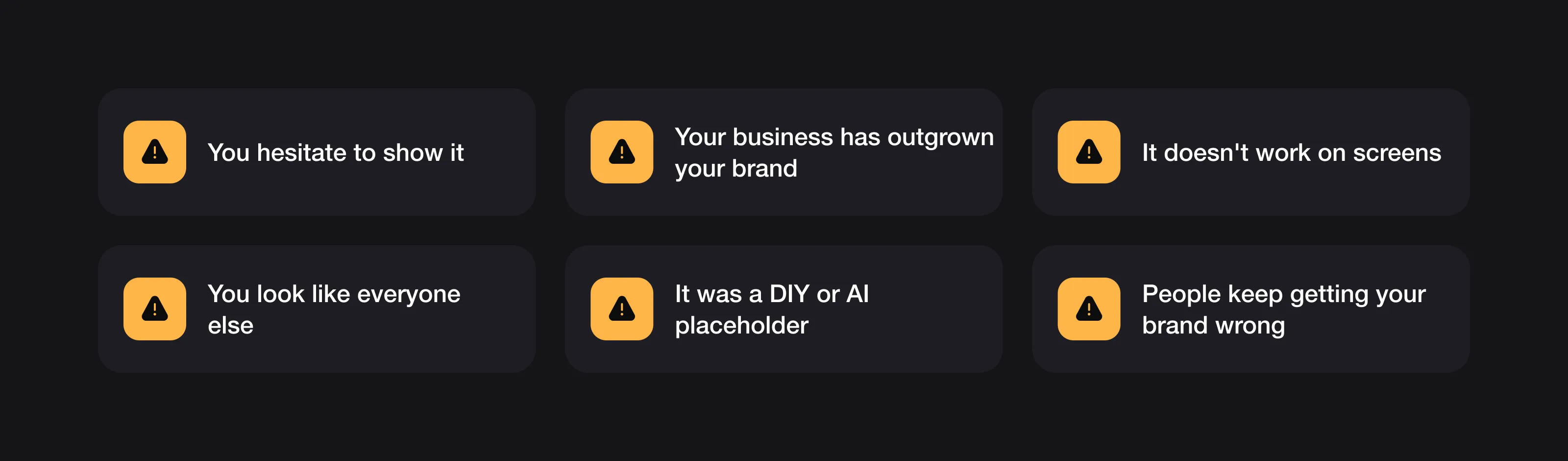 Six signs your logo is holding you back.
1. You hesitate to show it
This is the most reliable sign. If you feel a flicker of hesitation when you hand over a business card or share your website, your logo is failing at a basic job: making you proud of your brand.
If you’ve ever said “we made that years ago” or “we’re planning to update it”, you already know the answer.
2. Your business has outgrown your brand
This is the most common reason to rebrand, and it’s completely natural. You started as a solo consultant and now run a team of fifteen. You launched with handmade candles and now sell a full home range. You moved from selling to consumers to selling to businesses.
Your logo was designed for who you were, not who you’ve become. When your identity and your business no longer match, customers sense it, even if they can’t say why. Before you start, it helps to know how much a logo should really cost so you can budget properly.
3. It doesn’t work on screens
Many logos designed some years ago were made with print in mind. They look good on letterhead but fall apart as a social avatar, a browser tab icon or an app icon.
Today most people will meet your logo on a phone. If it’s illegible at small sizes, has no square or circular version for social profiles, or loses its impact on a small screen, it isn’t working where it matters most. You need a set of versions for different sizes, delivered in the right file formats.
4. You look like everyone else in your industry
Industries go through visual phases: navy blue and a serif for law firms, circular hand-drawn badges for coffee shops, lowercase blue wordmarks for tech start-ups.
If your logo blends into a sea of competitors, you’re giving up recognition, and recognition builds trust. Looking generic is also one of the main reasons a logo looks cheap.
5. Your logo was a DIY or AI placeholder
There’s no shame in starting with a DIY logo. When you’re bootstrapping, a logo maker or Canva gets you going. But at some point the placeholder needs to become a real brand asset.
DIY and AI logos share the same weakness: they’re made without considering your competitors, your audience or where your brand is heading. If your business has grown but your logo hasn’t, that gap costs you credibility. Compare a freelance designer and a logo design service to find the right way forward.
6. People keep getting your brand wrong
If people mispronounce your name because of how the logo is styled, or think you’re in a different industry because your identity sends mixed signals, your logo is creating friction instead of removing it.
A good logo should make three things clear at a glance: who you are, what you do and what level of quality to expect.
Refresh or full rebrand?
Rebranding doesn’t have to mean starting from scratch. Often the right move is a refresh: cleaning up an outdated logo, modernising the typography or creating the versions you’re missing, while keeping what people already recognise.
Burger King’s 2021 rebrand is a good example of keeping what works. Rather than inventing something new, it returned to a look close to its 1969–1999 logo, simplified for today’s screens.
As a rough guide:
- Refresh if people recognise your logo and the core idea still fits, but the execution looks dated or doesn’t work at small sizes.
- Rebrand if your business has changed direction, your logo was a placeholder, or it actively sends the wrong message.
Either way, aim for a logo that won’t need replacing again in a few years. Our guide to what makes a logo timeless explains what to look for.
FAQ
What is the difference between a logo refresh and a rebrand?
A refresh cleans up an outdated logo, modernises the typography or adds missing versions while keeping what people already recognise. A full rebrand makes more sense when your business has changed direction, your logo was a placeholder or it sends the wrong message.
What is the clearest sign it’s time to change my logo?
Hesitation. If you feel a flicker of hesitation when you hand over a business card or share your website, your logo is failing at a basic job.
Should I replace a logo I made in Canva or with AI?
At some point, yes. DIY and AI logos are made without considering your competitors, your audience or where your brand is heading, and once your business grows, that gap costs you credibility.
Does my logo need to work on mobile?
Yes. Most people will meet your logo on a phone, so it needs to stay legible at small sizes and have a square or circular version for social profiles.
Ready for a new logo?
At Logomint, you start with a short brief where you explain what your business has become and what your logo needs to say. A senior designer sends first concepts within 48 hours, and every plan includes full source files and a 100% money-back guarantee. See the plans, from €129.