Short answer In 2026 we’re seeing more subtle depth, animated and responsive logo systems, retro-inspired type and a move away from generic sans-serif wordmarks. Responsive logos are worth adopting whatever your brand; the rest only make sense if they genuinely fit your personality.
Trends are useful, but not as a to-do list
Every year brings a new round of “top logo trends” lists, and every year some founders redesign their logo to match. That’s usually a mistake. Trends are still worth understanding, though: they show you where visual language is heading and what your customers are getting used to seeing.
What follows are observations from the logos we see and design, not survey data. For each trend, we’ve added an honest view on whether it’s worth following.
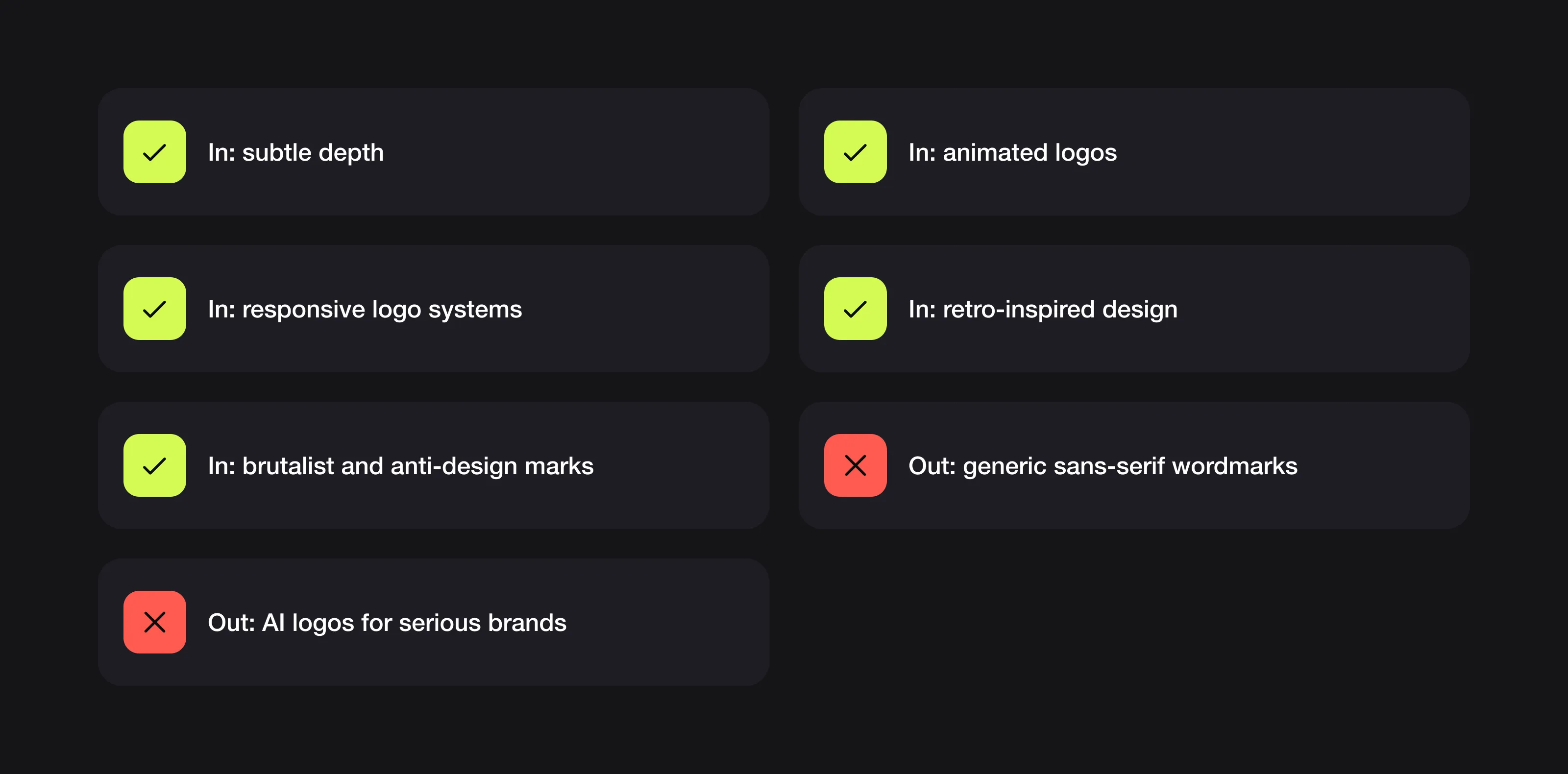 What is in and out for logos in 2026.
In: subtle depth
After a long period of strictly flat design, more logos are adding a little depth again: soft shadows, overlapping layers and gentle light effects that make a mark feel tangible.
This isn’t a return to the glossy, over-rendered logos of the 2000s. The new versions are restrained, more like flat design with one extra layer. Sharp, high-resolution screens make these details work.
Should you follow it? Only if feeling physical or premium matters to your brand, for example a craft or product brand. Always keep a flat version: depth effects don’t survive embroidery, stamping or one-colour printing.
In: animated logos
Static logos aren’t going anywhere, but more digital-first brands are adding an animated version for websites, app launch screens, videos and social media: a mark that assembles, shifts or reacts.
The animation should build on the static logo, not replace it. Your logo still has to work printed on a business card.
Should you follow it? If your brand lives mostly online, it’s worth considering. But design a strong static logo first, and animate it afterwards.
In: responsive logo systems
This has been building for years and is now standard practice. A responsive logo adapts to the space available: the full logo at large sizes, a simpler version in tight spaces, an icon for favicons and app icons.
Mastercard is a well-known example: its interlocking circles now often appear without the name. Small brands work the same way now, with a logo system rather than a single file. To support it, you need the right logo file formats for each version.
Should you follow it? Yes. This is less a trend than good practice, and it will outlast every other item on this list.
In: retro-inspired design
Designers are drawing on 1970s typography, 1990s colour palettes and vintage illustration styles, executed with modern precision. The best examples don’t copy old logos; they borrow the warmth and familiarity of an era and combine it with today’s clarity.
Should you follow it? If warmth, authenticity and approachability are central to your brand, it can work very well. If you’re a fintech that needs to feel cutting-edge, probably not.
In: brutalist and anti-design marks
At the other extreme, some brands are choosing raw typography, unusual layouts and a deliberately unpolished look, as a reaction to years of everything looking smooth and identical.
It suits brands that want to feel rebellious or countercultural. It doesn’t suit brands that need to feel trustworthy, reassuring or professional.
Should you follow it? Only if your brand genuinely has that attitude. Customers notice when edginess is borrowed.
Out: generic sans-serif wordmarks
In the late 2010s, a wave of fashion houses, tech start-ups and DTC brands adopted near-identical clean, all-caps sans-serif wordmarks. When everyone looks the same, nobody stands out, and several brands have since moved back towards more distinctive typography: serifs, custom letterforms and wordmarks with personality.
Should you care? If your logo is a plain sans-serif wordmark that could belong to any company in your sector, a refresh might be worth it. Lack of distinctiveness is one of the main reasons a logo looks cheap.
Out: AI-generated logos for serious brands
AI generators have improved, but they tend to remix familiar patterns. They don’t know your audience, your competitors or your plans, and the results often look alike. They’re fine for a placeholder or a side project. For a brand you want to build and protect, human-designed work is still the safer choice: the US Copyright Office says AI output is protected only where a human author determined its expressive elements, not through prompts alone.
Should you care? If your current logo came from an AI tool, compare your options for professional design before you print it on anything expensive.
Should you follow trends at all?
Here’s the practical test. Before adopting any trend, ask three questions:
- Does it fit my brand’s personality, or am I adopting it because it’s everywhere?
- Will the core logo still work if the trend fades? Keep the trendy element in the execution (an animation, a colour treatment, a campaign style) rather than in the mark itself.
- Does it work everywhere I need it? Favicon, packaging, one-colour print, social avatars.
If the answer to any of these is no, skip it. The logos that last are built on simplicity, meaning and versatility rather than on what’s fashionable this year. We cover those principles in what makes a logo timeless.
FAQ
What are the biggest logo design trends in 2026?
We’re seeing more subtle depth, animated and responsive logo systems, retro-inspired design and brutalist marks, along with a move away from generic sans-serif wordmarks. These are observations from the logos we see and design, not survey data.
What is a responsive logo?
A responsive logo adapts to the space available: the full logo at large sizes, a simpler version in tight spaces and an icon for favicons and app icons. It’s less a trend than good practice, and worth adopting whatever your brand.
Should I redesign my logo to follow a trend?
Usually not. Only adopt a trend if it fits your brand’s personality, your core logo would still work if the trend fades, and it works everywhere you need it, from favicons to one-colour print.
Is an AI-generated logo good enough for a business?
It’s fine for a placeholder or a side project. For a brand you want to build and protect, human-designed work is the safer choice, because the US Copyright Office says AI output is protected only where a human author determined its expressive elements, not through prompts alone.
The trend that actually matters
The best logo for your brand in 2026 is one designed for your business, your audience and your goals. Trends come and go; a clear, well-built logo keeps working.
At Logomint, a senior designer creates your logo from your brief, with first concepts in 48 hours and a 100% money-back guarantee. See the plans, from €129.