Short answer Sometimes, but copyright is where AI logos run into trouble. Trademark registration depends mainly on whether your logo is distinctive and doesn’t clash with earlier marks, while copyright generally requires a human author, so purely AI-generated artwork is unlikely to be protected by copyright in the US and faces similar doubts in the EU. The bigger practical risk is that AI tools can produce generic or look-alike logos that are hard to register and easy to challenge.
Copyright and trademark are not the same thing
Many articles on this topic mix the two up, and the difference matters.
| Copyright | Trademark | |
|---|---|---|
| What it protects | The artwork itself, as a creative work | Your logo as a sign that identifies your business |
| How you get it | Automatically, if the legal requirements are met | Through use in some countries, and more reliably through registration |
| Key requirement | Original work by a human author | Distinctive, and not confusingly similar to earlier marks |
| Where AI causes problems | Human authorship | Generic or look-alike designs |
| Scope | Copying of the work | Use of similar signs for related goods or services, in the territories where you’re protected |
So “can I trademark it?” and “do I own the copyright?” are two different questions with two different answers.
Copyright: why purely AI output is a problem
United States
The US Copyright Office has made its position clear: copyright protects works of human authorship. Its registration guidance, first published in 2023, asks applicants to disclose AI-generated material in a work, and it will only register the parts contributed by a human. In a later report on copyrightability, it concluded that prompts alone generally don’t give a person enough control over the output to count as its author. You can read its guidance on the US Copyright Office AI page.
The courts have backed the principle. In Thaler v. Perlmutter, a US federal court upheld the Copyright Office’s refusal to register an image that its creator said was made autonomously by an AI system with no human author, and the appeals court affirmed that decision in 2025.
That doesn’t mean anything touched by AI is unprotectable. Human contributions can still count, for example a person’s creative selection and arrangement of material, or substantial changes they make themselves. But the protection covers only the human part, and where the line falls is decided case by case.
European Union
In general terms, EU copyright law protects works that are the author’s own intellectual creation, which is widely understood to mean a human’s creative choices. Output generated by an AI tool from a short prompt is unlikely to meet that standard on its own, although the law in this area is still developing and national courts may differ in the details.
Other countries have their own approaches. The UK, for example, has a long-standing rule on “computer-generated works” whose application to modern AI tools is debated. If you operate internationally, don’t assume one country’s answer applies everywhere.
What that means for a logo
If your logo artwork isn’t protected by copyright, you can’t rely on copyright to stop someone copying the design. You’d have to rely on trademark law instead, which only covers use as a brand for related goods or services in the places where you have rights.
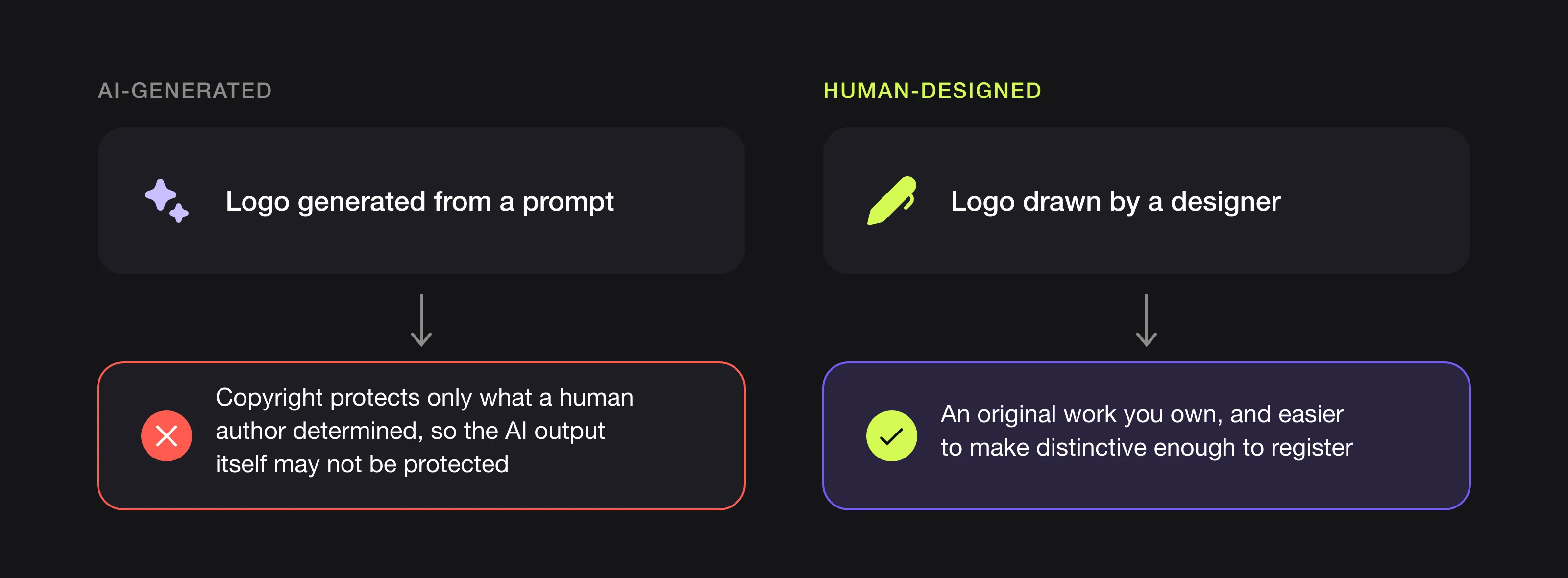 Why who made the logo matters for protection.
Trademark: a different test
A trademark protects a sign that tells customers who a product or service comes from. When a trademark office examines an application, the main questions are whether the sign is distinctive enough to identify your business, and whether it conflicts with marks that already exist. The published registration criteria focus on the sign itself, not on who or what drew it.
In practice, that means an AI-generated logo isn’t automatically disqualified from trademark registration. In the EU, you can register an EU trade mark with the EUIPO or register nationally, and owners of earlier marks can oppose an application they believe conflicts with theirs. Other trademark offices have their own procedures, but distinctiveness and prior marks are central almost everywhere.
The catch is that AI tools are not good at either of those things.
The real risks of using an AI logo
1. Look-alikes
AI image tools learn from enormous amounts of existing imagery, including existing logos. Their output can end up closer to someone else’s mark than you’d expect, and you have no easy way of knowing. A logo that resembles an earlier mark can be refused, opposed or challenged, and in the worst case you may have to rebrand after you’ve already printed, launched and built recognition. We cover this under logo red flags too.
2. Generic designs
AI tools tend to produce the same kinds of shapes: swooshes, abstract circles, lightbulbs, leaves. Generic marks are harder to register because they’re weakly distinctive, and they do little to make you recognisable. It’s the same problem as using a stock icon.
3. Nothing stops others generating something similar
Anyone can type a similar prompt into the same tool. Without copyright in the artwork, and before you have a registered trademark, your options against a close copy may be limited.
4. The tool’s terms of service
Who owns the output, and what you’re allowed to do with it, depends on the tool’s licence terms, and they vary. Some template-based platforms also restrict trademarking designs built from their stock elements. Read the terms before you build a brand on the result.
5. Questions from investors or buyers
If you raise money or sell your business later, you may be asked who created your brand assets and whether you own them. “An AI tool made it” is a harder answer to document than “a designer created it and transferred the rights to us”.
If you already use an AI logo
You don’t necessarily have to start over. Sensible steps:
- Search existing trademarks in the countries and categories where you operate, to see whether anything similar is already registered.
- Have a human designer substantially rework it, or use it purely as inspiration for a new design. A colour change or a new font isn’t enough to change who authored the artwork.
- Keep records of the design process: dated files, drafts and correspondence with the designer.
- Talk to a trademark attorney before filing, especially if you plan to expand internationally.
If the logo isn’t deeply embedded in your brand yet, starting fresh with a human designer is often simpler than trying to fix it. Our guide on how to get a logo designed walks through the process.
FAQ
Can I trademark a Midjourney logo if I edit it in Photoshop?
Trademark registration depends on distinctiveness and prior marks, not on the tool. For copyright, minor edits like changing colours or adding a border are unlikely to be enough; substantial human changes may be protected, but only those changes.
Does paying for a premium AI logo plan change anything?
Not for authorship. Paying more doesn’t make a person the author of the artwork. It may change the licence terms, so check what the plan actually gives you.
Are Canva logos trademark-eligible?
It depends on what the logo is built from. Templates and stock elements are shared with other users, and Canva’s licence terms place limits on trademarking designs that use them. A logo you build from your own original elements is in a different position. We compare the two routes in Logomint vs Canva.
Does this apply to app icons and other brand graphics?
Yes. The same copyright and trademark principles apply to all your brand assets, not just the main logo.
Should I disclose that my logo was AI-generated?
For a US copyright application, yes: the Copyright Office asks applicants to disclose AI-generated material. For trademark applications, requirements differ by office, so ask your attorney.
The bottom line
Using AI to brainstorm or build a mood board is fine. Using raw AI output as the logo you plan to build a business on carries real risks: weak or no copyright, generic designs and possible look-alikes. If your brand is worth protecting, it’s worth starting from an original design made by a person.
This article is general information, not legal advice. For decisions about your own trademark, speak to a qualified trademark attorney.
At Logomint, every logo is designed from scratch by a real senior designer, with no AI and no templates, and you get full ownership plus vector, printable and source files. It’s a solid starting point for a trademark search and application, from €129 with a 100% money-back guarantee. See the plans.